Comfort that holds all year.
This is a working HVAC contractor in the Bronx handling heating, air conditioning, and ductless systems for both residential and commercial properties. Whether you need a no-heat furnace call in Woodlawn or a new central AC in Country Club, the work starts with an on-site look, not a phone guess. Same-day service is available for no-heat and no-cool emergencies when the schedule allows.
Tell us about your hvac contractor job — we'll get you a fast quote.
A firm, all-in price confirmed before we start — no surprises.
On time, done to standard, and tidy when we leave.
Reach a real Bronx hvac contractor technician to describe the problem — no call-center runaround.
We look at the actual system and explain what is going on before any work.
You get the price for the fix up front and decide before we proceed.
Serving Bronx and the surrounding area — confirm coverage by phone.
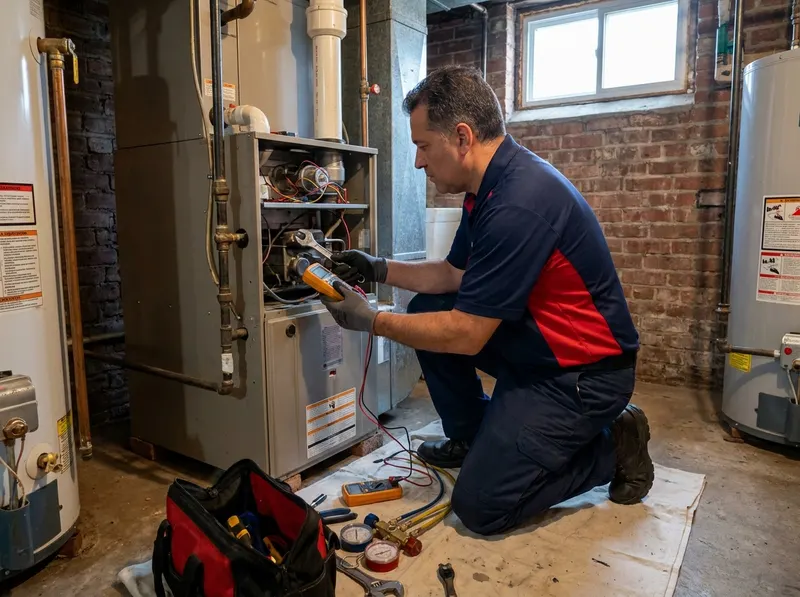
Older Bronx housing stock complicates furnace repair more than newer builds. Prewar buildings in Fordham and Mott Haven often run converted or aging forced-air units squeezed into tight basements, and access alone changes how a repair goes. A furnace that stops firing on a cold Riverdale morning usually points to one of a handful of culprits: a dirty flame sensor, a failed igniter, a tripped high-limit switch, or a clogged filter starving the blower. A proper diagnostic separates a $150 cleaning from a real part replacement, and that distinction is why the visit starts with testing, not selling.
Repair fits when the furnace is under roughly 12 to 15 years old, the heat exchanger is intact, and the failure is a single component. In that case a repair is far cheaper than replacement and buys years of service. Replacement becomes the smarter call when a heat exchanger is cracked — a carbon-monoxide risk that shuts the system down for safety — or when an oil furnace in a Throggs Neck or Country Club home has repeated failures and rising fuel costs. We flag which side of that line a unit falls on rather than pushing a new system by default.
The Bronx heating season is hard on equipment. Homes near Pelham Bay Park and Orchard Beach see salt-carrying coastal air that corrodes exterior venting, while radiator-to-forced-air conversions common around Kingsbridge and Woodlawn leave undersized ductwork that makes a furnace work harder and fail sooner. In apartment settings across Parkchester and Morris Park, shared flues and gas pressure need checking before a repair is called complete. Local conditions are part of the diagnosis, not an afterthought.
Pricing is always a ballpark until a technician sees the unit. A quoted range reflects typical Bronx repairs; the exact figure is confirmed on-site after the diagnostic, and no work proceeds without that confirmation. Call (929) 723-1104 to get on the schedule.
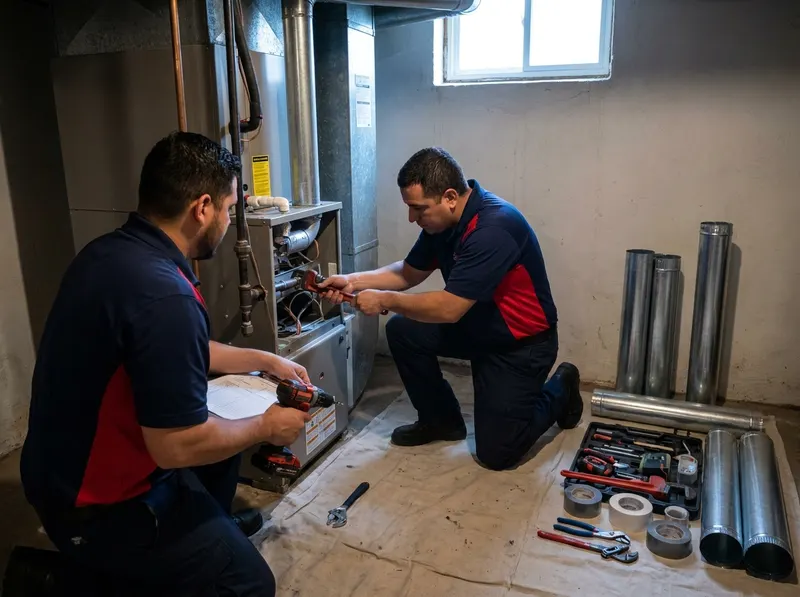
A new furnace should be sized to the house, not to whatever was there before. Many older Bronx homes were fitted decades ago with units that are now oversized, which causes short-cycling and uneven heat. Before quoting an install, the heat load is measured against the home's square footage, insulation, and window count so the replacement furnace matches the space. Row houses in Mott Haven and Parkchester often need a compact high-efficiency gas unit, while the larger detached homes in Riverdale and Country Club may call for higher-capacity systems to hold temperature during a cold snap off Long Island Sound.
Gas furnace installation fits most Bronx homes already piped for natural gas, and it is typically the lower operating-cost choice over a full winter. Electric furnace installation makes sense where there is no gas service or where adding a gas line is impractical, though it usually costs more to run month to month. The trade-off is upfront simplicity versus long-term energy cost: electric units install cleanly but carry higher heating bills, while gas units demand proper venting and combustion-air checks but heat more cheaply. During the on-site visit both options are laid out with real numbers for your specific home.
Venting and clearances matter in the tight basements common across Throggs Neck, Pelham Bay, and Morris Park, where the furnace often shares space with the water heater and laundry. Flue routing, combustion air, and condensate drainage for high-efficiency models are all confirmed before install day so there are no surprises. In Woodlawn and Kingsbridge, older masonry chimneys sometimes need a liner when a modern high-efficiency furnace is installed, and that gets flagged in the estimate rather than after the work starts.
Every furnace installation ends with a startup test: burner ignition, airflow, thermostat response, and safety controls are all verified while the crew is still on site. Fordham University-area two-family homes and the older stock near the Grand Concourse are handled the same way, so the system is proven working before anyone leaves.
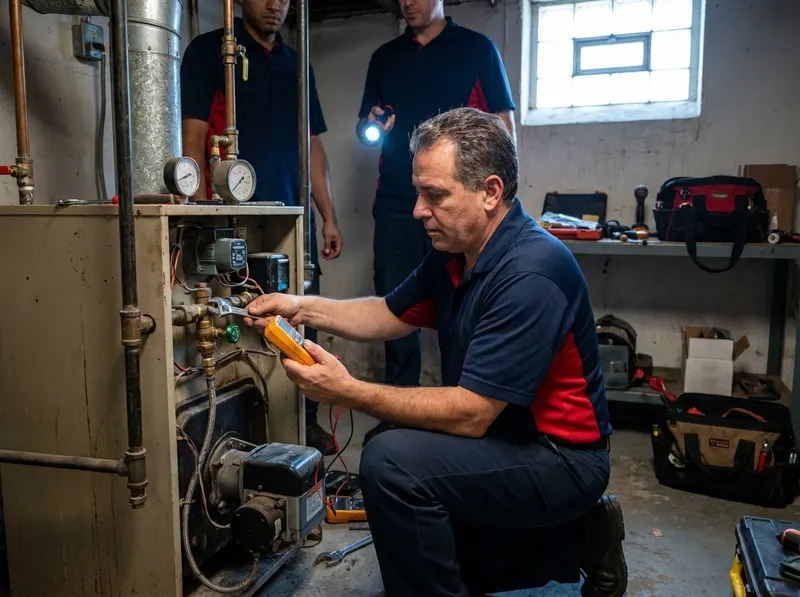
Bronx boilers face a specific set of problems. Older prewar buildings in Fordham, Mott Haven, and Kingsbridge still run one-pipe steam systems where knocking pipes, uneven heat between floors, and low water cutoff faults are the usual complaints. Single- and two-family homes in Throggs Neck, Country Club, and Pelham Bay more often have hot-water (hydronic) boilers, where a stuck circulator pump, an airlocked loop, or a failing expansion tank is the more common cause of cold radiators. A repair visit starts with identifying which system you have and what actually failed, rather than assuming.
A boiler repair fits when the unit is under roughly 15 years old and the fault is isolated — a bad aquastat, a leaking relief valve, a dead circulator, a clogged pilot or ignition assembly. In those cases a repair is far cheaper than replacement and restores heat the same visit in most situations. Replacement becomes the smarter call when the heat exchanger is cracked, the block is leaking internally, or repeated repairs are stacking up on a boiler past its useful life. On a service visit we tell you which side of that line the boiler is on, and why, before you spend on a part.
Humidity and coastal salt air near Orchard Beach and along the Throggs Neck and Pelham Bay waterfront accelerate corrosion on boiler jackets, vents, and fittings, so rust and flue issues show up faster on those systems than on inland units near Van Cortlandt Park or Woodlawn. Older gas lines and shared chimney flues in Bronx multi-families also mean venting and combustion get checked, not just the boiler itself. A seasonal tune-up before the first cold week — cleaning the burner, checking pressure and safety controls, bleeding the system — is the cheapest way to avoid a January no-heat call in a Riverdale or Parkchester walk-up.
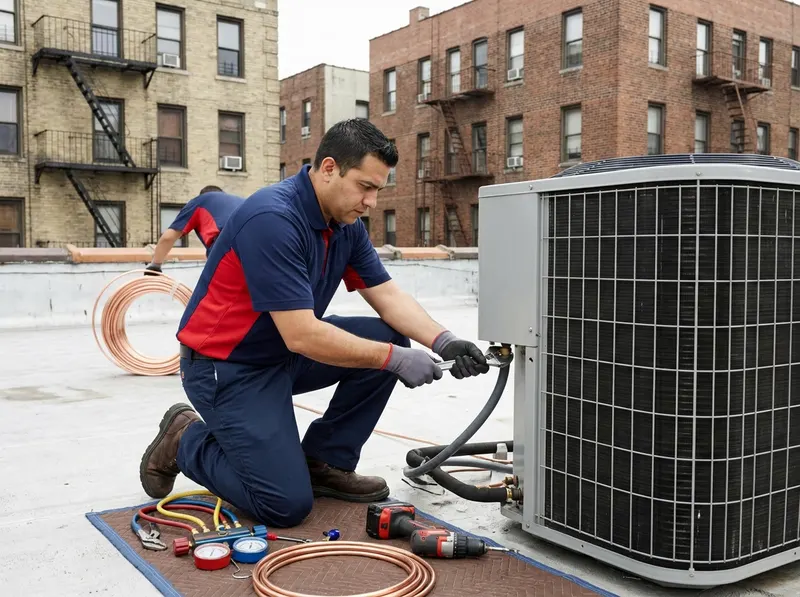
Central AC fits Bronx homes that already have ductwork or can accommodate it — many pre-war single-families in Riverdale and Country Club, plus renovated two-families in Morris Park and Woodlawn, are strong candidates. If your home has forced-air heating ducts, adding a central coil and condenser is usually the cleaner path. Homes without duct runs, or narrow rowhouses in Mott Haven where duct routing gets tight, often make more sense as ductless or high-velocity systems; we'll tell you honestly on-site which route suits the layout.
Sizing is the part that decides whether the system runs well for a decade. An oversized unit short-cycles and leaves rooms humid; an undersized one runs constantly on the hottest August afternoons near Pelham Bay Park. We size by square footage, ceiling height, window exposure, and insulation rather than guessing by tonnage. West-facing Fordham apartments over stores and top-floor units in Parkchester carry more heat load and often need that factored in.
The outdoor condenser needs a stable, level spot with airflow clearance — a side yard, flat roof, or rear pad works in most Throggs Neck and Kingsbridge homes. Refrigerant lines and a condensate drain route to the indoor coil, and the electrical tie-in usually needs a dedicated circuit at the panel. During the visit we check panel capacity, existing duct integrity, and where the lineset can run with the least disruption to finished walls.
The $150 minimum applies to any dispatch and covers the visit and assessment; it rolls into the job if you move forward. Because central AC pricing swings widely with tonnage, duct work, and access, we don't quote a firm number by phone — the exact figure is confirmed after we see the home.
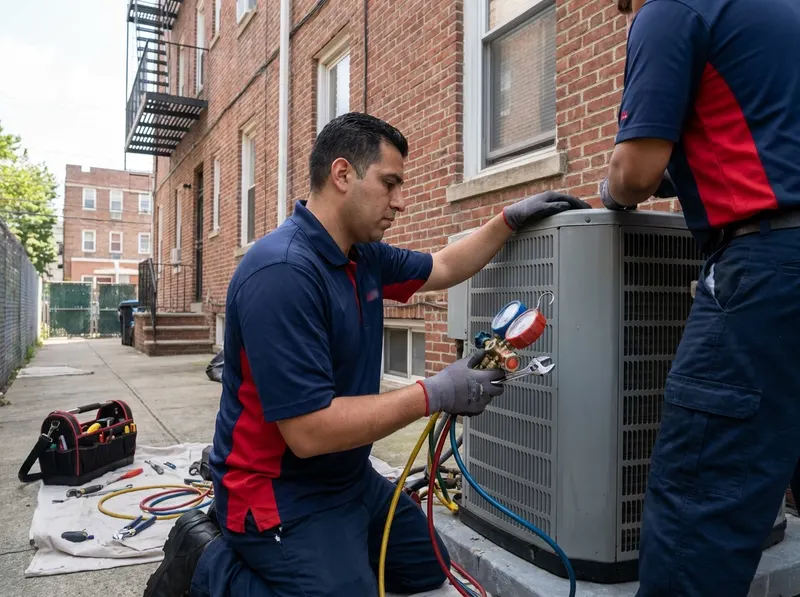
Central AC repair fits when the system is worth saving — most units under 12 years old with a single failed component. A blown capacitor, a stuck contactor, a clogged condensate line, or a low refrigerant charge are all repairs, not replacements. Full replacement only makes sense when the compressor fails on an aging system or the coil has a chronic leak; a technician will tell you which side of that line your unit falls on before any work starts.
Bronx housing shapes the repair. In Riverdale and Fieldston, older single-family homes often run condensers tucked beside the house or on flat roofs, where leaf debris off the tree canopy near Wave Hill and Van Cortlandt Park clogs coils and drops cooling capacity. In Throggs Neck, Country Club, and Pelham Bay, salt-laden air off the water corrodes contactor points and fan motors faster than inland units, so intermittent no-starts are common there. Attached homes in Morris Park, Woodlawn, and Kingsbridge frequently share tight mechanical closets where a backed-up condensate drain trips the safety float and shuts the whole system down — a quick fix that reads like total failure.
Co-op and multi-unit buildings around Fordham, Parkchester, and Mott Haven add their own wrinkle: shared electrical panels and roof access can slow a repair, so it helps to know your unit's location and whether building management controls the disconnect before the visit. A honest diagnostic separates the cheap fix from the costly one — a $20 capacitor and a compressor replacement present with similar symptoms, and only a proper test tells them apart.
The pricing below is a ballpark. The exact figure is confirmed on-site after the diagnostic, because the true cost depends on the failed part, refrigerant type, and access. Systems using older R-22 refrigerant cost more to recharge, and that alone can shift the number.
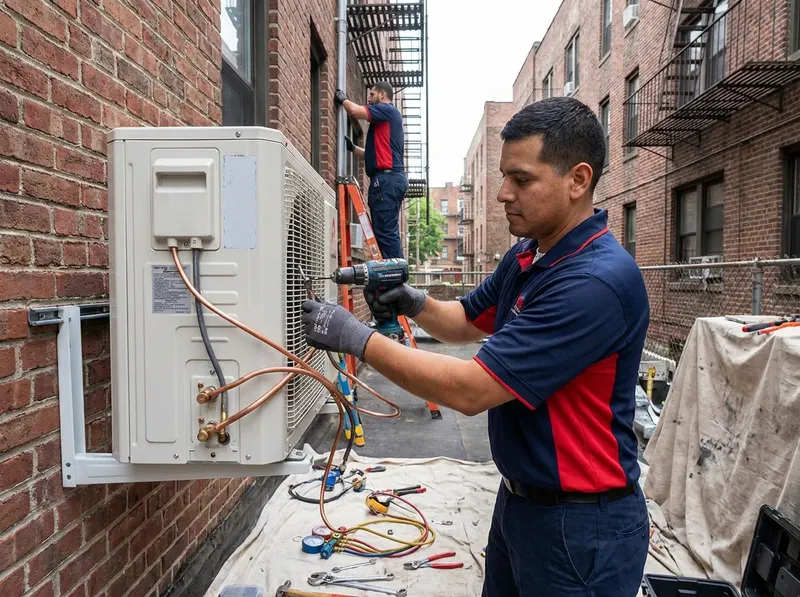
A ductless mini-split fits situations where a central system cannot go. Many Riverdale and Fieldston homes have finished attics or sunrooms that the original ductwork never reached, and a wall-mounted head solves the hot-and-cold-room problem without opening walls. In the pre-war walk-ups of Fordham and Mott Haven, where ceiling height and plaster make duct runs impractical, a mini-split only needs a three-inch hole through the exterior wall for the line-set. That small footprint is the main reason ductless installs are common in the Bronx's masonry housing stock.
Choosing between single-zone and multi-zone matters. A single-zone unit pairs one outdoor condenser with one indoor head and suits a single room, a converted garage in Throggs Neck, or a rear addition in Country Club. A multi-zone system runs several indoor heads off one outdoor unit, which fits a full-floor apartment in Parkchester or a two-family in Pelham Bay where each level needs independent temperature control. The trade-off is upfront cost: multi-zone equipment and labor cost more than adding window units, but the systems are quieter, far more efficient, and provide year-round heating down through cold Bronx winters.
Where central air with existing ducts is already in place, a mini-split is usually not the better value. Ductless makes the most sense when there is no duct network, when only part of a home needs conditioning, or when a landlord in Kingsbridge or Woodlawn wants to add heating and cooling to a specific unit without disturbing the rest of the building. Placement of the outdoor condenser also matters on tight Morris Park lots and shared alleys, so we confirm clearance and mounting during the on-site visit.
Every quote follows a free on-site assessment because the price depends on head count, line-set length, electrical capacity, and wall type. The ranges below are ballparks; the exact figure is confirmed in writing after we see the space. Call (929) 723-1104 to schedule.
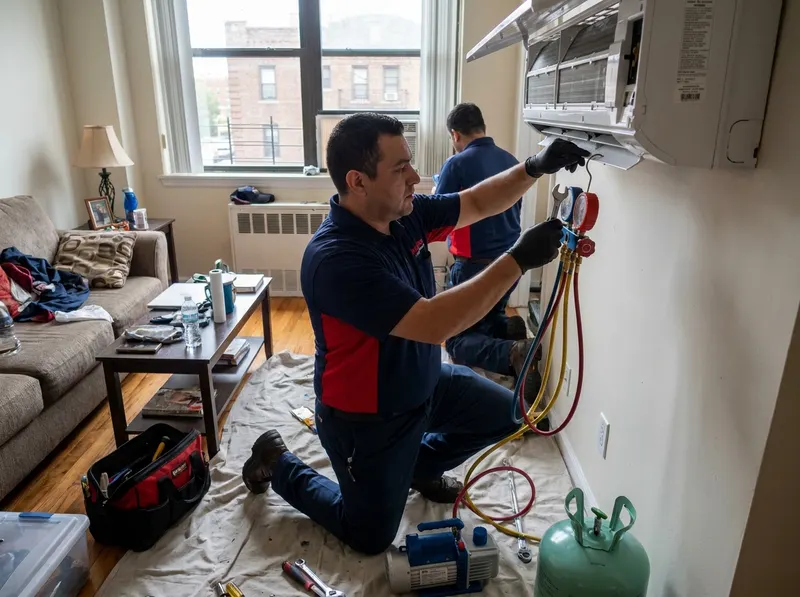
Ductless mini-splits fail in predictable ways, and the repair depends on which part is at fault. A common Bronx call is an indoor head that runs but blows warm air, which usually points to low refrigerant from a slow line-set leak or a fouled outdoor coil. A head that drips water onto the wall points to a clogged condensate line — a frequent issue in older Fordham and Mott Haven apartments where the drain routes through tight wall cavities. Blinking LED codes on Mitsubishi or Daikin units are read directly and matched to the fault, so the diagnosis is based on the system's own reporting rather than guesswork.
Mini-splits are popular across the Bronx precisely because so much of the housing stock was built without ductwork. Prewar buildings in Riverdale and Kingsbridge, brick two-families in Morris Park, and Throggs Neck and Country Club homes near the water all lean on ductless systems for room-by-room control. That waterfront air near Pelham Bay Park and Orchard Beach carries salt, which accelerates corrosion on outdoor condenser coils and fan components — a repair pattern seen far less in inland Woodlawn or Parkchester.
Repair fits when the unit is under roughly 10 years old and only one component has failed: a capacitor, a control board, a fan motor, or a single leaking flare fitting. Replacement becomes the better value when the compressor itself fails on an aging system, since a compressor swap often approaches the cost of a new outdoor unit. A technician will state which path makes sense for the specific system rather than pushing a repair that won't hold.
Multi-zone systems — one outdoor condenser feeding three or four heads in a larger Riverdale or Country Club house — take longer to diagnose because a fault in one zone can trace back to the shared condenser or a single branch of the line set. That work is quoted after the on-site diagnostic identifies the actual failed part.
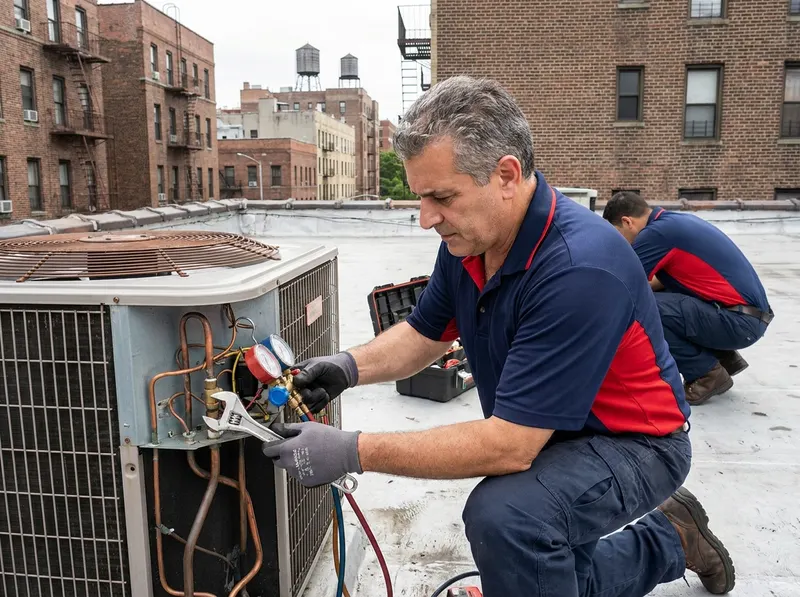
Commercial systems in the Bronx run harder than home units. A Fordham Road restaurant kitchen with make-up air, a Mott Haven warehouse with a bank of rooftop units, and a Parkchester office suite on PTACs each need a different service approach. Rooftop units on older Grand Concourse buildings often sit exposed to full sun and winter wind, so compressors, contactors, and economizer dampers wear faster than manufacturer schedules assume. Regular commercial maintenance catches those failures before a cooling loss shuts a dining room mid-service.
Choose full commercial service over a one-off repair when the equipment supports paying customers or tenants. A landlord in Kingsbridge or Riverdale managing several PTAC units across apartments benefits from a scheduled maintenance rotation rather than reactive calls, because coordinated filter changes and coil cleanings extend equipment life and keep tenant complaints down. The trade-off: a maintenance agreement carries a recurring cost, but it typically prevents the higher expense of an emergency compressor replacement during a July heat wave near Orchard Beach or a January freeze in Woodlawn.
Rooftop unit replacement is the larger decision. When an RTU is more than 15 years old and needs a compressor or heat exchanger, the repair cost often approaches half the price of a new, more efficient unit. For a Throggs Neck or Country Club commercial building, crane access, roof curb sizing, and Bronx permit requirements all factor into the quote, which is why exact numbers only come after an on-site look. We confirm curb dimensions, electrical service, and gas connections before committing to a figure.
All commercial pricing here is a ballpark. Bronx buildings vary widely in access, roof height, and existing wiring, so the exact price is confirmed during a free on-site visit rather than over the phone.
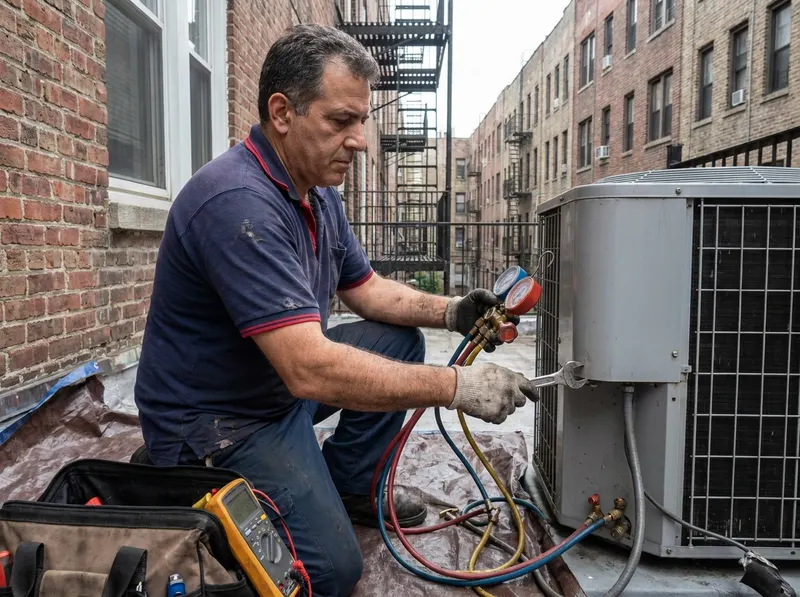
Maintenance fits when your system runs but you want to avoid a mid-winter no-heat call or a July AC failure. A tune-up before the season starts is the cheaper path; a full repair or replacement after a breakdown is the expensive one. For the older steam and hot-water boilers common in prewar Fordham and Mott Haven buildings, annual servicing matters more, not less, because sediment and mineral buildup accumulate faster in these systems. Central air condensers on rooftops and in tight side-yards around Morris Park and Parkchester collect leaf debris and grime that quietly cut efficiency each summer.
Schedule heating maintenance in early fall and cooling maintenance in spring. Two visits a year suits homes running both a furnace and central AC; one annual visit is often enough for a single heating boiler in a smaller Kingsbridge or Woodlawn apartment. The trade-off is straightforward: skipping tune-ups saves the visit fee now but shortens equipment life and raises the odds of an emergency repair during the coldest or hottest week. If your system is already making unusual noise or short-cycling, a repair diagnostic is the better call than routine maintenance.
Bronx housing stock shapes what a visit involves. Detached homes in Riverdale and Country Club often have accessible mechanical rooms, so tune-ups move quickly. Throggs Neck and Pelham Bay homes near the water see more coastal corrosion on outdoor condenser units, which a maintenance check catches early. Multi-family properties near Fordham University and along the Grand Concourse frequently share heating systems, and servicing those takes longer and is priced by system size rather than a flat unit rate.
An honest note on pricing: the ranges below are ballparks. The exact figure depends on how many systems you have, unit size, and access, and it is confirmed after the technician sees the equipment on-site. Nothing is quoted below the $150 minimum.
If your furnace or boiler is under about 12 years old and the failure is a single part, choose a repair — it fits when the rest of the system is sound and you want the lowest cost now. If the unit is 15-plus years old and failing repeatedly, choose a replacement, because repeated repair bills stack up against a new high-efficiency system that cuts fuel use. For a Bronx home or apartment with no existing ductwork, choose a ductless mini-split instead of forcing in central air, since ductless zones each room without tearing open walls. If you already have good ducts, central AC is usually cheaper per cooled square foot than adding several mini-split heads. The trade-off is straightforward: repair saves money today, replacement saves money over years, and the right choice depends on the age of the equipment and whether ducts already run through the building.
| On-site diagnostic / minimum charge | $150 (applies toward repair) |
| Furnace or boiler repair | $150–$650 typical |
| Furnace replacement | $3,800–$7,500 depending on size and efficiency |
| Central AC repair | $150–$700 typical |
| Central AC installation | $5,500–$11,000 with ductwork condition |
| Ductless mini-split (single zone) | $3,500–$6,000 installed |
| Ductless mini-split (multi-zone) | $7,000–$15,000 by head count |
| Seasonal tune-up | $150–$250 per system |
Call for a firm, all-in price before any work begins.
We give an upfront, written price before any work begins — you approve it first. No surprises.
Our work is done to standard and we stand behind it — a real fix, not a quick patch.
We’ll give you an honest assessment. If you don’t need the work, we’ll tell you.
The Bronx housing stock runs older than most of the city, and a lot of it — the brick rowhouses off Fordham Road, the pre-war walk-ups in Mott Haven — was built for steam and hot-water heat with no ductwork at all. That is why ductless mini-splits are so common here: they add real cooling and supplemental heat without ripping open plaster walls that have stood since before Yankee Stadium's current build. Homes near the water in Throggs Neck and Country Club also see faster outdoor-coil corrosion from the salt air off Pelham Bay, so those condensers earn a closer look during maintenance.